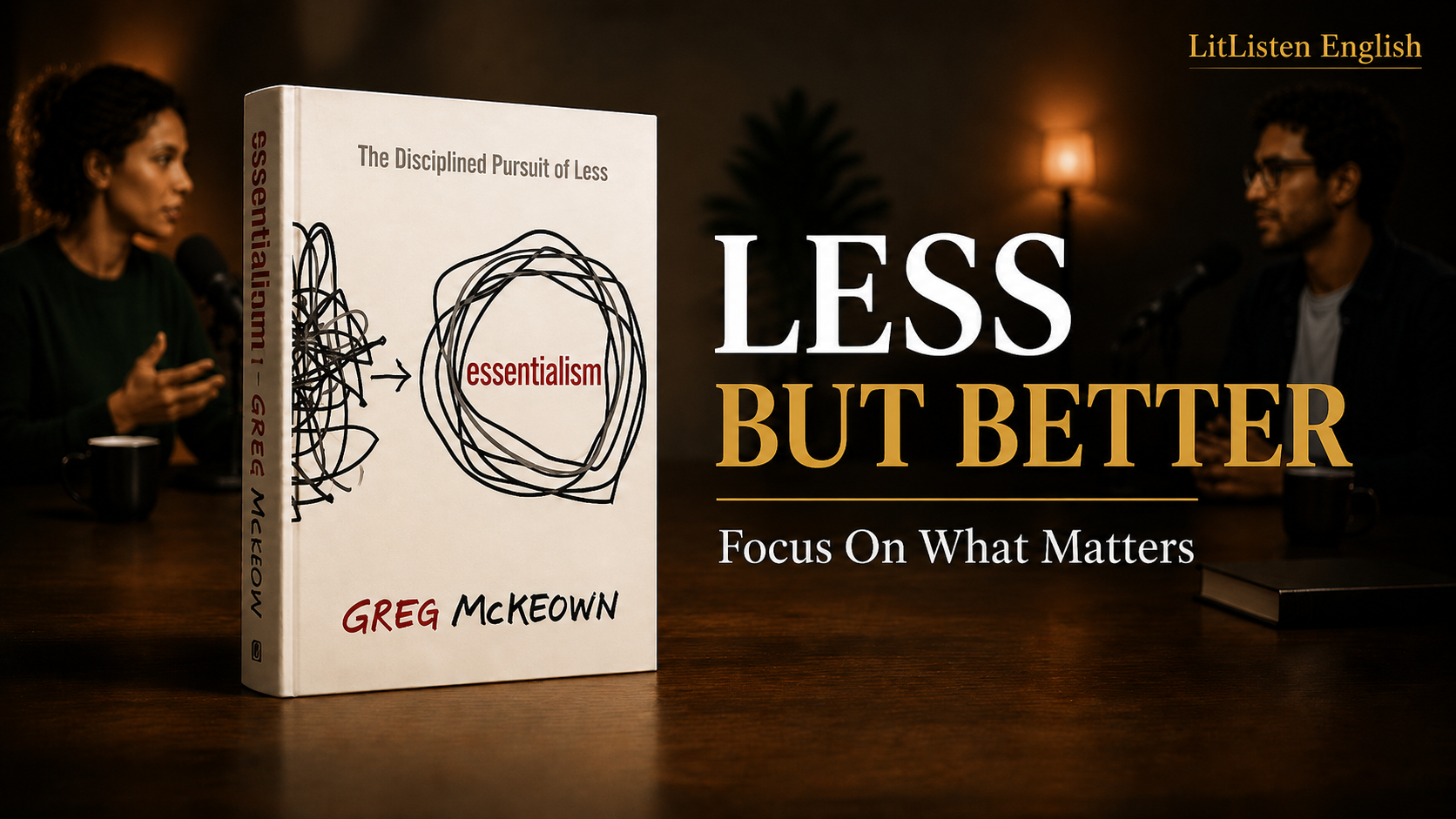
Welcome to a special Lit Listen English edition of our Deep Dive.
I am so glad you are joining us today.
Yes, welcome.
We are thrilled to be part of your learning journey.
And since you, our listener, are likely an English listening trainee, we want to make this as accessible as possible.
So we're going to be speaking clearly and at a very comfortable, moderate pace today.
Exactly.
We want you to really absorb the concepts and the language.
Right.
And today's topic is a big one.
We are looking at a book called Essentialism by Greg McKeown.
Our mission for this Deep Dive is to figure out how to escape that awful trap of being, you know, busy but not productive.
Oh, that is such a common trap.
It really is.
We're going to learn how to get the right things done by relentlessly pursuing less but better.
Oh, and a quick heads up about vocabulary.
Yes, the vocabulary.
Right, because this is Lit Listen English.
We will naturally pause a few times during our chat to highlight and explain some advanced English words and useful idioms directly from the text.
That way you get the big ideas and some practical language skills at the same time.
Exactly.
So let me start with a story.
Have you ever felt like you are majoring in minor activities?
Just stretched completely thin.
I think we all have at some point.
Well, there was this guy, Sam Elliott.
He felt exactly that way.
He was a highly capable Silicon Valley executive.
Yeah.
And his company had recently been acquired.
Which is always a stressful transition.
Totally.
And he desperately wanted to be seen as a team player in this new corporate structure.
So he just started saying yes to literally everything.
Oh, no.
That is a recipe for disaster.
Yeah.
Every meeting invite, every email chain, every minor committee.
And, well, his reward for all that effort was that he almost lost his mind.
His stress must have just skyrocketed.
It did.
The quality of his work tanked.
And he was seriously considering taking an early retirement package just to escape the pressure.
But before he quit, a mentor gave him some pretty radical advice.
What did the mentor say?
He told him, stay, but from now on, do only what you would do if you were an outside consultant.
Nothing else.
And don't tell anyone.
Wow.
Just act like a consultant and keep it a secret.
Right.
So Sam actually did it.
He stopped going to meetings where he wasn't making a direct decision.
He stopped volunteering for all those extra committees.
And let me guess, he didn't get fired.
Nope.
The exact opposite happened.
He bought himself space to think.
His performance ratings went up.
He got his family life back.
And he actually earned the largest bonus of his career.
What's fascinating here is that the story of Sam Elliott is the perfect entry point.
Because it really highlights a trap that highly intelligent, capable people fall into every single day.
Yeah.
Why does that happen to smart people?
Well, it comes down to a psychological mechanism the author calls the paradox of success.
And it works in four predictable phases.
Okay.
Lay them out for us.
So phase one, you have clarity of purpose.
And that focus leads you to succeed at your job.
Makes sense.
Focus equals success.
Right.
Then phase two, because you are successful and reliable, you gain a reputation as a highly competent go -to person.
Okay.
Let's unpack this.
Because, wait, isn't being the go -to person exactly what we all want in our careers?
I mean, we want our bosses to value us.
Why is gaining a good reputation a bad thing?
It isn't bad on its own, but it triggers phase three.
When you become that go -to person, you are suddenly presented with increased options and opportunities.
People want your input on everything.
Exactly.
But opportunities is actually just corporate code for increased demands on your time and energy, which leads inevitably to phase four.
Which is?
You become entirely distracted from what would otherwise be your highest level of contribution, the very effect of your success.
Those new demands.
Right.
Those demands have completely undermined the clarity that created your success in the first place.
You end up making a millimeter of progress in a million directions.
Your energy becomes dangerously diffused.
Ah, you just used a really great word there.
Diffused.
Since our listeners are actively building their English vocabulary, let's grab that as our first focus word today.
Diffused.
D -I -F -F -U -S -E -D.
It's a great word to know.
Yeah.
I usually think of a diffuser, you know, like the device that spreads essential oils into the air of a room.
How does it apply to our work habits?
That is actually the perfect mental image.
To be diffused means to be spread out over a large area rather than concentrated in one powerful spot.
Okay, so spreading out instead of focusing.
Exactly.
When the book talks about your efforts being diffused, it means you are giving a tiny little bit of attention to a dozen different projects rather than pouring all your attention into one vital project.
That makes total sense.
Could you give us a quick everyday conversational example?
Sure.
You might say her attention was diffused across too many assignments, so none of them were finished on the deadline.
Perfect.
We spread ourselves out until we are too thin to make an impact.
You know, it reminds me of a brilliant historical fact from the text regarding the word priority.
Oh, I love this part of the book.
It's so interesting, right?
So the word came into the English language in the 1400s.
And for 500 years, it was strictly singular.
It meant the very first thing, the prior thing.
Just one thing.
Just one.
It was only in the 1900s that society pluralized the term and started talking about having multiple priorities.
We illogically reasoned that by changing the language, we could somehow bend reality and have multiple first things at the exact same time.
Which is a physical impossibility.
Literally impossible.
Right.
So to escape this trap of diffused energy, we have to adopt the core mindset of an essentialist.
And that requires accepting three harsh realities.
We must choose, we must discern, and we must accept trade -offs.
Let's start with choosing, because I feel like people often think they have no choice but to take on the busy work their boss hands them.
They do feel that way.
And the author points to a psychological concept called learned helplessness to explain this.
It was discovered through experiments by a researcher named Martin Seligman.
Right, the dog experiments.
Yes.
Seligman placed dogs in a box where they received a mild negative stimulus they could not escape.
And eventually the dogs just laid down and stopped trying.
That's so sad.
It is.
But here is the tragic part.
Later, when the researchers removed the barrier so the dogs could easily jump to safety, the dogs still didn't try to escape.
They had learned to be helpless.
Wow.
And think about how that applies to your own job or personal life.
Do you, you know, just accept every meeting invite because you feel you have to?
Exactly.
We feel overwhelmed by demand, so we surrender our power to choose.
We act like those dogs.
We forget that the barrier isn't there anymore.
We forget that choice is an action we can take.
And once we reclaim that power to choose, we have to discern what is actually worth choosing.
This brings us to the second reality.
The book points out that almost everything in the world is just noise.
It uses the Pareto principle.
Oh, let's quickly unpack the Pareto principle for our listeners because it gets thrown around in business a lot.
It is the idea that inputs and outputs are heavily unequal.
Right.
The 80 -20 rule.
Exactly.
Specifically, that 20 % of our efforts produce 80 % of our results.
So if you were looking at a to -do list of 10 items, two of those tasks actually matter more than the other eight combined.
And some scientists even talk about a power law where certain efforts produce exponentially better results, far beyond the 80 -20 rule.
Like who?
Well, look at Warren Buffett.
The author describes his investment philosophy as practically lethargic.
Lethargic meaning very slow and inactive.
Right.
Buffett owes 90 % of his massive wealth to just 10 investments.
Mm -hmm.
He says no to thousands of very good financial opportunities just to wait for the few truly essential ones.
He knows how to discern the vital few from the trivial many.
But waiting for those vital few, that requires the third most difficult reality, the trade -off.
Trade -offs are so hard for people to accept.
They are because you simply cannot have it all.
And the business world shows us exactly the mechanism of what happens when you try to avoid trade -offs.
Look at the airline industry.
Oh, the Southwest Airlines example.
Yes.
Years ago, Southwest Airlines made deliberate, painful trade -offs to become a low -cost airline.
They decided, you know, no meals, no assigned seats, no first -class cabins, just simple point -to -point flights.
And it was a massive financial success.
Huge.
But then a competitor named Continental Airlines looked at Southwest's success and tried to copy it, but without giving up their existing premium model.
They tried what the author calls a straddled strategy.
Let's actually pause on that phrase because it brings us to our second vocabulary word, straddle.
S -T -R -A -D -D -L -E.
Right.
Straddle.
We usually hear this in a physical context, like straddling a bicycle or a horse where you have one leg on each side.
How does it apply to Continental Airlines?
Well, in a figurative sense, to straddle means trying to support or engage in two different, often conflicting things at once.
You are refusing to choose a side.
Ah, so trying to have your cake and eat it, too.
Exactly.
Continental Airlines tried to straddle the market.
They wanted to keep their full -service premium flights with hot meals and baggage transfers, but they also launched a low -cost service called Continental Light to compete with Southwest.
They were trying to keep one foot in both worlds.
And the mechanism behind that failure was brutal.
You cannot physically turn an airplane around in 15 minutes at the gate if you also have to load hundreds of hot meals onto it.
You just can't.
Right.
By trying to be everything to everyone, Continental Airlines ended up delaying planes, bleeding hundreds of millions of dollars, and the CEO was eventually fired.
That is what happens when you ignore trade -offs.
It's a harsh lesson.
It is.
And to make this relatable to your everyday life, just think about your clothes closet at home.
Oh, the closet analogy is great.
Yeah, if you never actively organize it, it just gets stuffed with sweaters and jackets you never wear.
When you finally decide to clean it out, if you hold up a shirt and ask yourself, will I wear this someday?
Well, you will end up keeping everything.
Because the answer to someday is always yes.
Exactly.
You have to ask a much tougher question.
Do I love this?
I am so glad you brought up the closet analogy, because it beautifully maps onto the three -step process of the essentialist.
This is how we actually practice the philosophy daily.
Explore, eliminate, and execute.
Okay, let's look at step one.
Explore.
That is taking everything out of the closet and looking at it.
Yes.
And it sounds like a paradox, but essentialists actually explore far more options than non -essentialists before they commit to anything.
Wait, really?
They explore more.
They do, because they are only going to choose one or two things to go big on.
They evaluate a wide range of options using a very strict metric called the 90 % rule.
How does that work?
As you evaluate an opportunity, you think about the single most important criterion for that decision.
Then you rate the option between 0 and 100.
If you rate it anything lower than a 90, even an 89, you automatically change the score to 0 and reject it.
Wait, let me challenge that for a second.
If I rate every opportunity in my life and reject everything under a 90%, aren't I just going to end up doing nothing?
That sounds completely paralyzing.
It does sound extreme at first.
Because most things in life, most job opportunities or social invitations are a solid 75.
If I reject them all, I'll just be sitting in an empty room.
And this raises an important question.
When do we actually apply this rule?
You don't use the 90 % rule to decide what to eat for lunch.
Right, that would be exhausting.
You use it for your most significant resources.
Your career moves, your major projects, your deepest relationships.
The mechanism here is about forcing your brain to stop agonizing over decisions that are just okay.
If you fill your calendar with 75 % opportunities, you will have no room left when a true 95 % opportunity finally comes along.
I see what you mean.
It creates a massive filter for the big stuff.
So we've explored our options and found the 90 % items.
Now for step two, eliminate.
This is the hardest part.
It really is.
Going back to our closet analogy, this is where you actually have to put a close in the trash bag.
Yeah.
And at work, that often requires the emotional discipline to say no to people.
Saying no is incredibly hard for most of us.
Here's where it gets really interesting.
Because saying no feels so dangerous.
But the book shares a story about Stephen Covey, the famous author.
He was walking with his young daughter when he unexpectedly ran into an old friend he hadn't seen in years.
Oh, I remember this.
Yeah.
And the friend was thrilled and invited Covey to dinner right then and there.
It was a rare, wonderful opportunity.
But Covey politely declined.
How did he do it without offending the friend?
The mechanism is displacing the rejection.
Covey had already promised his daughter they would spend the evening together.
So he rooted his no in a pre -existing commitment.
He wasn't rejecting the friend.
He was honoring a boundary he had already set.
The author notes that having a clear internal intent acts like a force field against distractions.
That is a great way to reframe it.
But even with a force field, eliminating things can be incredibly difficult for our brains to process.
And that is largely because of something called sunk cost bias.
Ah, sunk cost bias.
Let's make that our third vocabulary focus.
S -U -N -K hyphen C -O -S -T.
Tell us about this psychological trap.
Sunk cost bias refers to the human tendency to continue investing in a failing project or to keep an old item simply because we have already put time, money, or effort into it.
Like keeping a heavy jacket because you paid $300 for it even though it doesn't fit anymore.
Exactly.
The psychological pain of admitting a loss is so high that we keep going, even when it makes no logical sense.
To break the bias, an essentialist asks a different question.
Which is?
If I were not already invested in this, how much would I be willing to spend to acquire it today?
That is powerful.
Think about how often we fall for this at work.
And you might think, well, I'm going to spend another week on this terrible presentation because I already spent three weeks on it last month.
Yes, that is classic sunk cost bias.
If you wouldn't start the project today from scratch, you have to have the courage to cut your losses.
Which brings us to the final step in the cycle.
Execute.
Right.
Explore, eliminate, execute.
So once you've thrown out the clothes you don't need, you have to organize the closet so getting dressed in the morning is completely frictionless.
And non -essentialists tend to force execution.
They push harder.
They pull all -nighters.
They rely on adrenaline and last -minute panic.
We've all been there.
Oh, definitely.
But essentialists do something different.
They invest the time they saved by eliminating things into removing obstacles.
The author illustrates this mechanism with a business parable about a manager trying to fix a slow production plant.
Oh, the Boy Scout story.
Yes.
The manager goes on a hike with his son's Boy Scout troop and notices the line of boys keeps stretching out because some walk fast and others walk slow.
One boy named Herbie is the slowest hiker and he is holding the entire troop back.
So instead of standing at the back of a line and yelling at Herbie to walk faster.
Which is what a lot of bosses would do.
Right.
Instead of that, the manager looks for the actual constraint.
He finds out Herbie's backpack is incredibly heavy.
So they take the cans of food out of Herbie's backpack and distribute them among the faster kids.
It's such a simple solution.
It is.
By removing the specific obstacle slowing Herbie down, the entire troop moves faster with far less effort.
In our corporate lives, we have to find our Herbie.
Maybe it's a slow approval process from the legal department.
If you fix that one bottle match, everything else flows naturally.
Exactly.
The author actually quotes Hermione Granger from the Harry Potter series to illustrate this kind of focus.
Hermione says her logic allows her to look past extraneous detail to perceive what others overlook.
Extraneous detail.
Let's make extraneous our fourth and final vocabulary word today.
E -X -T -R -A -N -E -O -U -S.
What is a conversational way to think about that word?
When we say something is extraneous, we basically mean it is extra fluff.
It is information or detail that is completely irrelevant to the core subject.
It doesn't add value.
It only causes distraction.
So how would I use that in a sentence?
A simple, everyday example would be, please keep your project update short and leave out any extraneous information so the boss doesn't get confused.
I love that.
So when you are executing your essential tasks, aggressively remove all the extraneous details, the extra fluff, and the bottlenecks.
If we connect this to the bigger picture, all these mechanics exploring with the 90 % rule, gracefully saying no, beating sunk cost bias, and removing extraneous obstacles, these are not just corporate productivity hacks.
They're a lot deeper than that.
They are.
They are the tools for living a life of true meaning.
Near the end of the book, the author tells a deeply moving story about a grieving father whose three -year -old daughter had passed away.
Oh, this story is heartbreaking.
It is.
The father wanted to put together a memorial video of her short life.
So he went through hours and hours of home videos from all the vacations and outings they had taken as a family.
But as he watched the footage, he realized a tragic truth.
What did he realize?
He had recorded the sites they had seen, the famous landmarks they had visited, the meals they had eaten, but he had almost no close -up footage of his daughter's face.
In his frantic attempt to capture everything happening around him, he had missed recording the only thing that was truly essential.
Wow.
So what does this all mean?
For you, the listener, the message is that essentialism isn't just about managing your email inbox.
It is a profound lifestyle choice designed to protect your precious limited time on this earth.
Because if you do not prioritize your life, someone else will gladly do it for you.
Exactly.
It is about recognizing that every time you say yes to a minor extraneous request, you are implicitly saying no to something that might be deeply meaningful.
The life of an essentialist is a life lived without regret.
If you correctly identify what really matters to you, whether that's your family, your health, or a specific creative calling, and you invest your focused energy there, you will become profoundly proud of the life you have chosen.
It really is a beautiful philosophy.
But before we sign off, I want to leave you with a provocative thought to ponder, something that wasn't explicitly detailed in the book.
Oh, let's hear it.
Well, if we adopt these extreme criteria, right, if we ruthlessly apply the 90 % rule and eliminate everything that isn't a definitive resounding yes, do we risk eliminating the beautiful serendipity of life?
Oh, that is a really good point.
Think about it.
How do you balance this strict filtering system with the reality that some of the greatest joys, the most important relationships, and the most amazing discoveries often come from unexpected, seemingly non -essential accidents?
Like a random conversation at a party.
Exactly.
A party you didn't even want to attend turns into a lifelong friendship.
How do we leave room for the magic of the unknown while still fiercely protecting our time?
That is a brilliant question to reflect on.
It challenges us to consider whether we need to actively define openness to serendipity as one of our essential priorities.
A priority to be open.
I love that.
Well, thank you so much for joining us for this Lit Lissa English deep dive.
We hope you enjoyed the clear pacing and a breakdown of today's vocabulary.
Yes, make sure you practice using those new words.
Right.
Try to use diffused, straddle, sunk cost bias, and extraneous in your own conversations this week.
And as you go through your days, remember the story of Sam Elliott.
Be the outside consultant in your own life.
Give yourself the permission to step back, find your highest point of contribution, and boldly pursue less, but better.
Until next time, keep listening and keep learning.
Participant Participant!!!!!
Participating Participating