Imagine for a second that you are trudging up this really steep, incredibly muddy hill.
Oh man, that already sounds terrible.
Right. And you are carrying this massive, heavy backpack.
And it is just loaded to the brim with rocks.
It's just weighing you down.
Exactly. Your shoulders are aching, your breathing is super shallow, you are totally exhausted.
But you assume you absolutely have to carry this weight.
Because someone put those rocks in there years ago.
Yeah, exactly. Your past put them there. You know, your childhood, your bad experiences, your traumas.
It's just a given that you have to carry them.
But what if I told you that you are actually choosing to carry that heavy backpack right now,
simply because you are afraid of what would happen if you put it down and, well, had to actually run?
That just completely flips the script on how we view our entire lives.
I mean, we are so deeply comforted by the idea that our past causes our present struggles.
It gives us a reason for why we're stuck.
Right. It gives us an excuse.
And taking away that excuse.
Yeah.
That is genuinely terrifying.
It really is terrifying.
And it is exactly the philosophical rabbit hole we are jumping into today.
It's a deep one, too.
It totally is.
And hey, if you are joining us to pick up some nuances of the English language, you are in the perfect place.
Today's deep dive has a dual mission.
Which I love, by the way.
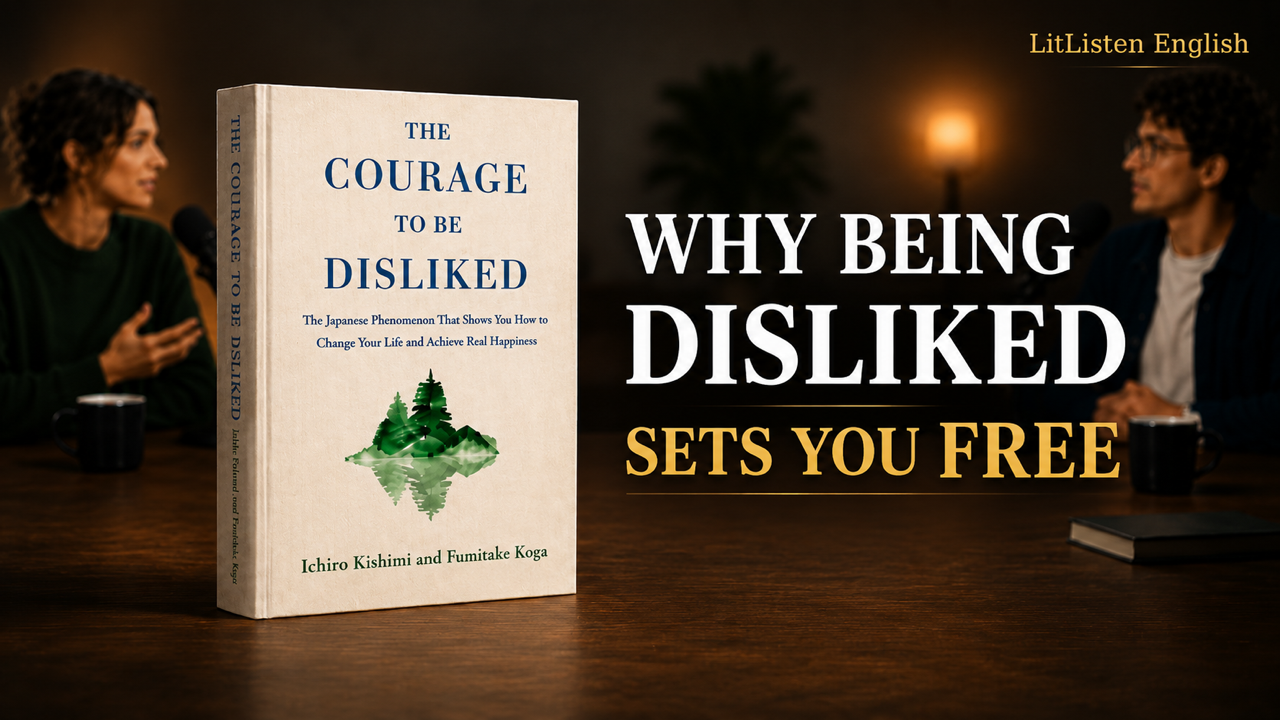
Yeah. We are going to explore the truly mind-bending, paradigm-shifting concepts of the international bestseller,
The Courage to be Disliked.
And as we untangle these complex ideas, we're going to highlight some fantastic English vocabulary and idioms that pop up along the way.
It really is a perfect combination.
The book itself is essentially a master class in debate and dialogue, actually.
Because it's not written like a normal self-help book, correct?
No, not at all. It's structured in a very unique way. It's written as a Socratic dialogue.
So instead of a dry textbook, you are reading this continuous, often heated conversation.
Like a literal argument between two people.
Exactly. Between this deeply unhappy, cynical young man and a wise philosopher living on the outskirts of a city.
And through their arguments, the book breaks down the theories of Alfred Adler.
Now, if you aren't familiar with Adler, he is a giant of psychology.
An absolute legend.
Yeah, he stands right alongside Sigmund Freud and Carl Jung.
But he is often called the unknown third giant.
Which is a shame, honestly.
It is. But his ideas were so radical and like so far ahead of their time that they just didn't catch on in the mainstream the exact same way Freud's did.
Well, Adler's psychology presents very straightforward answers to the ultimate philosophical question, which is basically, how can a person be happy?
Sounds simple enough.
You'd think so.
But as you hinted at with the backpack analogy, his answers are incredibly challenging to accept.
They require a complete rewiring of how you view cause and effect.
They really do.
I mean, this deep dive is going to challenge everything you think you know about trauma, about what actually causes your daily unhappiness, and how you interact with friends, family, and coworkers.
It's going to shake things up.
Definitely.
By the end, we are going to explain why true freedom actually requires being disliked by other people.
So let's start right out of the gate with the book's most shocking, controversial claim.
Lay it on me.
Adlerian psychology definitively, adamantly, denies the existence of trauma.
Okay, wait.
Let's unpack this immediately, because when I read that line, I slammed on the brake.
Most people do.
My defenses went straight up.
Saying trauma doesn't exist sounds, I don't know, horribly dismissive of people's real visceral pain.
It really does sound harsh.
Yeah, we see the effects of terrible past experiences all the time.
You can't just say that doesn't exist.
I know.
It sounds incredibly callous at first glance.
But to understand what Adler actually means, we have to look at the fundamental difference between Freudian etiology and Adlerian teleology.
Okay, etiology and teleology.
Right.
So Freud's view, etiology, is basically the study of causation.
It essentially says the past determines the present.
Like cause and effect.
Exactly.
You suffered a psychic wound or trauma in the past, so you are unhappy or anxious now.
Which is exactly how most of us think.
Like, I might say, I have trust issues today because I was betrayed five years ago.
It's just simple cause and effect.
Right.
It treats humans almost like machines.
A past cause dictates a present effect.
But Adler completely rejects this.
And he introduces teleology.
Yes, teleology, which is the study of purpose.
Mm-hmm.
Teleology says our present and our future are not determined by past occurrences.
Okay, so what drives us then?
Instead, our present behavior is driven entirely by our present goals.
So we aren't being pushed from behind by our past.
We are being pulled forward by what we want right now.
Exactly.
Adler argues that we do not suffer from the shock of our experiences.
Instead, we make out of them whatever suits our purposes.
But how does that apply to, like, severe anxiety?
The book uses an example of a person who refuses to leave their house.
They have this intense crippling fear about stepping outside.
A classic case of agoraphobia.
Right, so Freud would say, let.s delve into their childhood and find the past trauma that caused this.
What does Adler say?
Adler says they have a present goal of not going out.
And they're manufacturing the anxiety and fear to achieve that goal.
Manufacturing it?
That almost makes it sound like they're faking it.
No, not faking it.
The fear is incredibly real.
The physical symptoms are real.
But they are created as a means to an end.
Why would someone have the goal of staying inside, though?
Well, maybe they want the special care and undivided attention of their parents.
Or maybe they are terrified of stepping out into the world and realizing they're just average.
Oh, that they aren't special.
Exactly.
So they create the fear to avoid facing that reality.
The anxiety is just a tool.
Wow.
Okay, this actually brings up a fantastic idiom used in the text that perfectly captures this idea of emotions as tools.
Oh, the coffee shop story.
Yes.
So the young man in the book is arguing with the philosopher about this exact point.
He tells a story about reading at a cafe.
A waiter walks by and accidentally spills hot coffee all over the young man's brand new, expensive jacket.
The worst.
Total nightmare.
The young man gets absolutely furious, starts screaming, and he tells the philosopher he couldn't help it.
He says he just had to blow his top.
That is such a vivid, perfect phrase for that moment.
It really is.
So for you listening, to blow one's top means to suddenly become very angry, to lose your temper in a loud, explosive way.
Like a volcano.
Exactly.
Just picture a literal volcano erupting and blowing the top of the mountain off.
In everyday conversation, you might say, I was already running late, and when I walked outside and saw a flat tire, I just blew my top.
It perfectly captures that feeling of instant, uncontrollable rage.
And that is exactly where I struggle with Adler. The young man makes the exact same argument I want to make. He blew his top at the waiter. He yelled instantly.
It felt like a reflex.
Yes, a pure reflex. How in the world can a present goal be involved when anger just erupts out of nowhere in a fraction of a second? You don't sit there, stroke your chin, and plan to get mad.
It certainly feels instant. It really feels like an uncontrollable force that overtakes you.
But the philosopher counters this with another brilliant, very relatable story.
The phone call one, right.
Yes.
Imagine a mother and daughter are having a screaming match.
The mother is yelling. Her face is red. She is just furious.
Right in the middle of this, the telephone rings.
I love this example.
The mother snatches up the receiver, still barking, hello.
But then she realizes it is her daughter's homeroom teacher on the phone.
Oh, I know exactly where this is going.
Right. In a split second, her voice changes, becomes sweet, calm, and perfectly polite.
Oh, hello, Mr. Smith. How are you?
She chats amiably for five minutes.
And then?
Then the moment she hangs up the phone, she turns right back to the daughter.
Her face goes red again, and she resumes screaming.
Wow. Okay, I think we have all witnessed something exactly like that.
Or let's be honest, done it ourselves.
We absolutely have.
And what does that story prove?
It completely dismantles the idea that anger is an uncontrollable force.
Because if it were uncontrollable, she couldn't have just switched it off for the teacher.
Exactly. Anger is just a tool.
It can be put away in a drawer when the phone rings and pulled right back out when you hang up.
So, applying that to the cafe story, the young man didn't fly into a rage and then happened to shout.
He got angry so that he could shout.
Precisely.
His goal was to overpower the waiter, to make the waiter submit and apologize profusely.
The tool he fabricated in an instant to achieve that goal was anger.
He could have just politely asked for dry cleaning money.
Right.
But he felt that would take too much time or wouldn't assert his dominance enough.
So he manufactured the anger.
That is a remarkably tough pill to swallow.
Because if Adler is right, it means we are entirely 100% responsible for our emotions.
We can't blame anyone else.
We cannot blame them on our past and we cannot say, oh, I couldn't help it.
It is a heavy burden, yes.
Right.
But flip it around.
It is also the ultimate empowering message.
Well, if you are not controlled by the ghosts of your past and you are not a helpless victim of your emotions, it means you have the free will to change your life right this very second.
Okay, I'm tracking with you.
But if we aren't victims of our past trauma, then what is actually causing all of our day-to-day unhappiness, our stress, our anxiety?
This leads us to Adler's core sweeping premise.
He states that all problems are interpersonal relationship problems.
All of them.
That sounds way too absolute.
It does, doesn't it?
Yeah.
I mean, what if I'm stranded alone on a desert island and I'm starving?
That's a problem and it has absolutely nothing to do with other people.
Adler would categorize that as a survival problem, a physical fact of nature.
But when we talk about psychological problems, worry, self-hatred, jealousy, anxiety about the future,
he argues that if you were the only person in the universe alone in space, those internal problems would vanish.
Just completely disappear.
Yes.
Even worrying about your career success or your physical appearance only exists because there are other people around to compare yourself to.
The philosopher in the book actually shares a really vulnerable personal example to illustrate this.
He mentions that he is 61 inches tall, which is about 5 foot 1.
We're a pretty short guy.
Yeah.
And for a long time in his youth, he agonized over it.
He felt deeply inadequate.
But when you think about it, height is just an objective measurement, right?
Like water boiling at a certain temperature.
It is neither good nor bad on its own.
Exactly.
It is just a number.
The feeling of inferiority is entirely a subjective assumption.
He only felt short because he was comparing his objective height to the height of other people in his interpersonal sphere.
Right.
But then a friend pointed out something interesting.
The friend told him that his small size actually put people at ease.
Oh, that's fascinating.
Yeah.
It made him approachable.
Whereas large, imposing men often made people nervous.
So his objective height didn't change at all.
But his subjective interpretation did.
Right.
Suddenly, through a shift in perspective, his height transformed from a painful deficit into a massive asset for building interpersonal relationships.
It was never about the height.
It was always about how he related to others.
Which brings us to another fascinating language nuance the book dives into.
The philosopher talks extensively about having an inferiority complex.
A very common phrase.
It is.
Now, in everyday English, we throw this phrase around casually just to mean someone feels bad about themselves.
Like, oh, she has an inferiority complex about her singing voice.
But Adler uses this term in a very specific, much more advanced way, doesn't he?
He does.
And the distinction is really crucial for our listeners to understand.
Adler says that a normal feeling of inferiority is actually healthy.
Because it acts as a launch pad.
Exactly.
You feel you are lacking in some area, so you strive to grow, study, and improve.
But an inferiority complex is a condition where you begin to use your feeling of inferiority as an excuse.
Ah, so it becomes a shield.
Yes.
An everyday example based on Adler's definition would be something like,
he never applies for a management promotion because he has an inferiority complex about not having a college degree.
He uses A, the lack of a degree, as a concrete excuse for why he cannot achieve B, career success.
Exactly.
He convinces himself that the causal link is absolute.
But wait, let me push back on this on behalf of everyone listening because I really struggled with this chapter.
Push away.
Isn't a lack of education a real objective barrier in the world?
Like, if I want to drive a car but the car has no wheels, I can't just say,
oh, I'm using the lack of wheels as an excuse.
Because you literally cannot drive the car.
Right.
Systemic barriers exist.
Lack of money or education blocks you from certain paths.
That is an objective fact, not a complex.
It certainly seems that way, and society absolutely reinforces that belief.
But Adler calls this apparent cause and effect.
Apparent cause and effect.
Yeah.
You are convincing yourself there is a strict, unbreakable, causal relationship where there actually isn't one.
The reality is there are always alternative paths.
But they're usually much harder.
Exactly.
There are extra grueling efforts you could make.
You could start your own business.
You could learn a trade.
Or you could pursue a completely different definition of success.
But doing those things is incredibly hard.
Yes.
It requires massive painful effort.
It requires stepping into the unknown and facing potential rejection.
Adler says it's not that you can't succeed without the degree.
It's that you don't want to sacrifice your current comfort to make those realistic, difficult efforts.
You lack the courage to change your lifestyle.
Oh, I see.
So you use the complex to protect your ego.
It is much safer to say I could be a huge success if only I had that degree than it is to actually try, fail, and be judged by others.
Yes, exactly.
You use it to avoid the interpersonal tasks of work, friendship, and love.
Because you're terrified of failing and having other people look down on you.
Okay, so if we accept this, if we realize we are using excuses to avoid the judgment of others, what do we practically do about it?
How do we free ourselves from this constant heavy burden of worrying about what everyone else thinks?
This is where Adler introduces what I consider his most revolutionary and liberating idea.
I know what you're going to say.
The separation of tasks.
The separation of tasks.
Basically, mentally drawing a line in the sand.
Yes.
To free yourself, you must draw a firm, absolute boundary between your tasks and other people's tasks.
How do you know which is which?
When you face any choice, you ask yourself, whose task is this?
And the way to figure that out is to ask who ultimately is going to receive the direct result of the choice that is made.
Okay, that makes sense.
You do not intervene in other people's tasks, and you fiercely refuse to let them intervene in yours.
Let's make this concrete for the listeners.
Say I decide to make a major life pivot.
I quit a stable, high-paying corporate job to become a struggling artist because it's my passion.
A classic scenario.
Right.
My task is simply making the choice I believe in and dealing with the financial realities of it.
But if my parents get angry, if they cry, if they call me irresponsible and criticize me, whose task is that?
That is their task.
How they react to your choice, what they think of you, whether they like you or dislike you, that is entirely their task to manage, not yours.
Which is so hard to internalize.
It is.
But you cannot live your life trying to satisfy the expectations of your parents, your boss, or society.
Because if you do, you are literally living someone else's life.
This concept of severing ties to other people's expectations brings up a fantastic English idiom the philosopher uses when talking about toxic relationships.
He says sometimes you just have to cut the Gordian knot.
Oh, I love the history behind this phrase.
It's a great story. According to ancient legend, there was a knot so impossibly tightly tangled that prophecies said no one could ever untie it.
And then Alexander the Great comes along.
Exactly. He looked at this massive mess of ropes, and instead of spending days trying to untangle it by hand, he just drew his sword and sliced the entire knot in half with one strike.
Problem solved.
Right. So today, when I say someone cuts the Gordian knot, it means they take a bold, decisive, and entirely unconventional action to solve a highly complicated problem.
It's the perfect metaphor.
It is. You might say, the executives were arguing for months about how to fix the broken software, so the new CEO cut the Gordian knot and just threw the whole system out to start from scratch.
And separating tasks is exactly like cutting that knot in our personal lives.
Yeah.
We get so hopelessly tangled in wanting to please everyone, trying to untangle their feelings and our desires, but Adler says you just have to slice through it.
You let go of their tasks completely.
Yes.
But hold on a second. Slicing through relationships. Letting go of what people feel. I really struggle with the how of this.
It's not easy.
How do you deal with the guilt? Isn't this just being incredibly selfish and self-centered? It almost sounds like a narcissist's handbook like, I do what I want and I don't care about your feelings.
It is so counterintuitive, I know. But Adler turns that assumption completely upside down. He argues that trying to please everyone and constantly craving recognition is actually what makes you intensely self-centered.
Wait, how does wanting to please people make you self-centered?
Because when you are constantly worried about how you look, what people think of you, and trying your hardest not to be disliked, you are obsessing over the I.
Oh, wow.
You appear to be looking at other people, but in reality, you are only thinking about yourself and your own ego. You are using other people simply as mirrors to reflect a good image back to you.
That hits incredibly hard. We think we are being generous by people-pleasing, but we are actually just protecting ourselves.
Exactly. True freedom, therefore, is the courage to be disliked. Being disliked by someone is not a tragedy to be avoided. It is actual proof that you are exercising your freedom.
It means you are living by your own principles rather than swearing loyalty to everyone else's expectations.
Precisely.
Okay, but let's take this to its logical conclusion. If we cut the Gordian knot and we just stop caring if people dislike us, don't we end up totally isolated and alone?
That's the fear.
Right. If I just walk around saying, that's your task, not mine, to everyone in my life, I'm going to end up on that desert island we talked about earlier.
That is the ultimate danger if you stop at the separation of tasks. But separating tasks is just the starting point of interpersonal relations. It clears the brush.
So what's the finish line?
The ultimate goal of Adlerian psychology is something he calls community feeling.
Community feeling? Right. Because humans are inherently social creatures.
We need a place of refuge. We need to feel like, you know, it is okay for me to be here.
We absolutely do. And to achieve this true community feeling, we have to examine how we structure our relationships.
Adler says most of us live in vertical relationships.
Vertical meaning like a ladder.
Exactly. Relationships based on hierarchy. We look up to bosses or mentors and we look down on subordinates or children.
We praise people when they do what we want and we rebuke them when they don't.
Wait. Even praising someone is considered a vertical hierarchical act.
I always thought praising people was a purely positive thing.
Adler says no.
Because praise is essentially a judgment pass from a person of ability to a person of no ability.
Yeah. When a mother says good boy to a child who helped with chores, she is evaluating him from above.
It is a form of manipulation to get him to repeat the behavior.
So what's the alternative?
Adler says to achieve community feeling, we must transition to horizontal relationships.
We must treat everyone as equal, but not the same.
Equal, but not the same.
Yes. Instead of praising or rebuking, we encourage.
We assist them in finding their own courage, treating them as a pure equal.
The book points out how toxic vertical environments can be.
And when advising a person who feels trapped in a bad vertical hierarchy like an oppressive workplace or a clique at school,
the philosopher tells them to listen to the voice of the larger community.
Yes. To look outside their bubble.
Exactly. To realize that the drama in front of them is just a storm in a teacup.
That is such a brilliantly evocative, very British idiom.
It is. For our learners, a storm in a teacup means a lot of unnecessary worry, anger, or drama over a problem that is actually very small when you step back and look at the big picture.
A great way to put it.
So you might say, my coworkers spent three days screaming at each other over the font size on the new memo.
But honestly, it was just a storm in a teacup.
Because in the grand scheme of things, font size doesn't matter.
Right. When you realize the world is huge, the little toxic vertical community you are stressing over loses all its power.
You realize you belong to the global community, to the universe even.
But transitioning to horizontal relationships brings up a critical, painful issue for a lot of people.
Which is?
If we aren't chasing praise anymore, and we aren't trying to achieve a higher status on a vertical ladder, how do we feel we have any worth?
Exactly. I mean, our whole society is built on this.
If I'm not getting a promotion or winning an award or getting an A on a test, how do I know I matter?
It's the million dollar question.
What if someone is bedridden, sick, and physically cannot work or achieve anything?
Do they have no worth in Adler's eyes?
This is where Adler draws a profoundly beautiful distinction between the level of acts and the level of being.
Okay. Acts versus being.
From childhood, we are taught to judge ourselves on the level of acts, what we do, what we produce, the grades we get.
But true human worth comes from the level of being simply existing.
The philosopher gives that really moving example of a parent in the book.
If your mother is in a terrible car accident and is in critical condition in the ICU, you aren't standing over her bed wishing she would get up to cook dinner or achieve a milestone at work.
Not at all. You are just profoundly grateful that she is still breathing. You are grateful for her being.
Wow. Yeah.
We have to learn to apply that exact same lens to ourselves.
We must build our sense of worth purely on existing and feeling that we contribute to others just by being part of the community, not on achieving vertical status.
Which brings us to the ultimate question.
If we aren't striving for superiority and we aren't exhausting ourselves climbing a corporate or social ladder, how are we supposed to actually live our lives day to day?
We have to find what Adler brilliantly calls the courage to be normal.
The courage to be normal. That almost sounds like an insult in today's world.
Because humans desperately want to be special.
We think being normal means being incapable or boring.
True.
If people can't get attention by being especially good, like the honor roll student or the star athlete, they will often try to be especially bad, like the delinquent who acts out or commits crimes.
So both extremes are just desperate attempts to be special and avoid being normal.
Exactly. We equate a successful life with reaching some grand destination on a mountaintop.
Right. But Adler argues that life is not a strict line moving toward a destination.
No, it's not.
Because if life were just about climbing the mountain to reach the peak, then all the years you spend hiking are just a tentative life. It's just a waiting room.
And if you fall or never reach the peak, your life is deemed a failure.
The book uses an incredible visual analogy for this that completely changed my perspective.
Imagine you are standing on a dark theater stage.
Okay, painting the picture.
If the house lights are somewhat dim, you can look out and see the back of the theater.
You can see your past and you can see your distant future.
But if a blindingly bright, intense spotlight is shining straight down on you right where you stand.
Wait, let me rephrase that.
Right where you stand, under this massive light, you can't even see the front row.
You're just blinded by the light.
Right. You can't see the past and you can't see the future.
You can only see the present moment.
That is exactly how we should live.
Adler calls this an energeial life.
Energeial.
Yeah. It is not kinetic. It is not about moving from point A to point B as fast as possible.
An energeial life is like dancing.
I love that.
You aren't dancing just to arrive at a specific spot on the floor.
The goal is the dance itself.
If you dance earnestly in the here and now, under that bright spotlight,
your life is always complete in that exact moment.
So whether the music stops at age 20 or age 90, it was a complete life of dancing.
Absolutely. So the greatest life lie of all, the biggest tragedy,
is to ignore the present moment, to refuse to dance,
and instead focus all your energy on regretting a fabricated past
or agonizing over a distant future.
Exactly. You just have to dance.
You just have to dance.
Wow.
We have covered some massive life-altering paradigm shifts today.
We learned to shed the comforting illusion that our past trauma dictates our future.
Which is huge.
We explored the difficult necessity of separating our tasks from the tasks of others
and finding the profound actual freedom in having the courage to be disliked.
And finally, we saw the beauty in abandoning the vertical ladder of success
to simply dance earnestly in the present moment.
It is a philosophy that requires immense courage, as the title says,
but it promises a life of incredible lightness.
It really does.
And a quick encouraging recap for you, our English learners.
Today, you tackled complex, nuanced psychology in a second language,
which is no small feat.
Be proud of yourselves.
Definitely.
As you continue practicing, remember to use your new terms to sound more natural.
We all know people who occasionally blow their top when they are stressed.
We certainly do.
Don't let an inferiority complex become an excuse to avoid trying.
Don't be afraid to cut the Gordian knot when a toxic relationship is hopelessly tangled.
And remember that most daily drama you encounter is really just a storm in a teacup.
Perfect recap.
And I want to leave you with a final provocative thought to mull over,
building on everything we've explored today.
Let's hear it.
If the past truly does not exist to define you,
and the future is a completely blank page waiting to be written,
what specific intentional meaning will you choose to assign
to this exact irreplaceable moment right now to ensure your life is complete today?
Think back to that heavy, muddy backpack full of rocks we talked about at the very beginning of our deep dive.
You don't actually have to carry it.
The past isn't strapping it to your shoulders.
You can choose right now to take it off, leave it on the path,
step under the spotlight, and just start dancing.
Keep listening.
You have reached the end of the The Courage to Be Disliked transcript.
Explore the library →