Imagine working your entire life, saving every single penny you can,
sacrificing your weekends and vacations, and then taking your last breath with,
I don't know, a million dollars just sitting untouched in your bank account.
Right, which most people in our society would call, you know, a massive financial success.
Exactly. But the author of the book we are diving into today calls it an absolute tragedy.
So welcome to Lit Listen English, everyone.
We are so glad you're joining us for this deep dive today.
Yeah, and since this deep dive is designed specifically for you, our English listening trainees,
we are going to make sure to speak clearly and at a nice moderate pace.
Right. Our goal is always to bring you fascinating ideas in clear, accessible conversations.
And today, well, we are tackling a concept that might completely shatter how you view your career.
Oh, absolutely. Your career, your savings, and really just your finite time on earth.
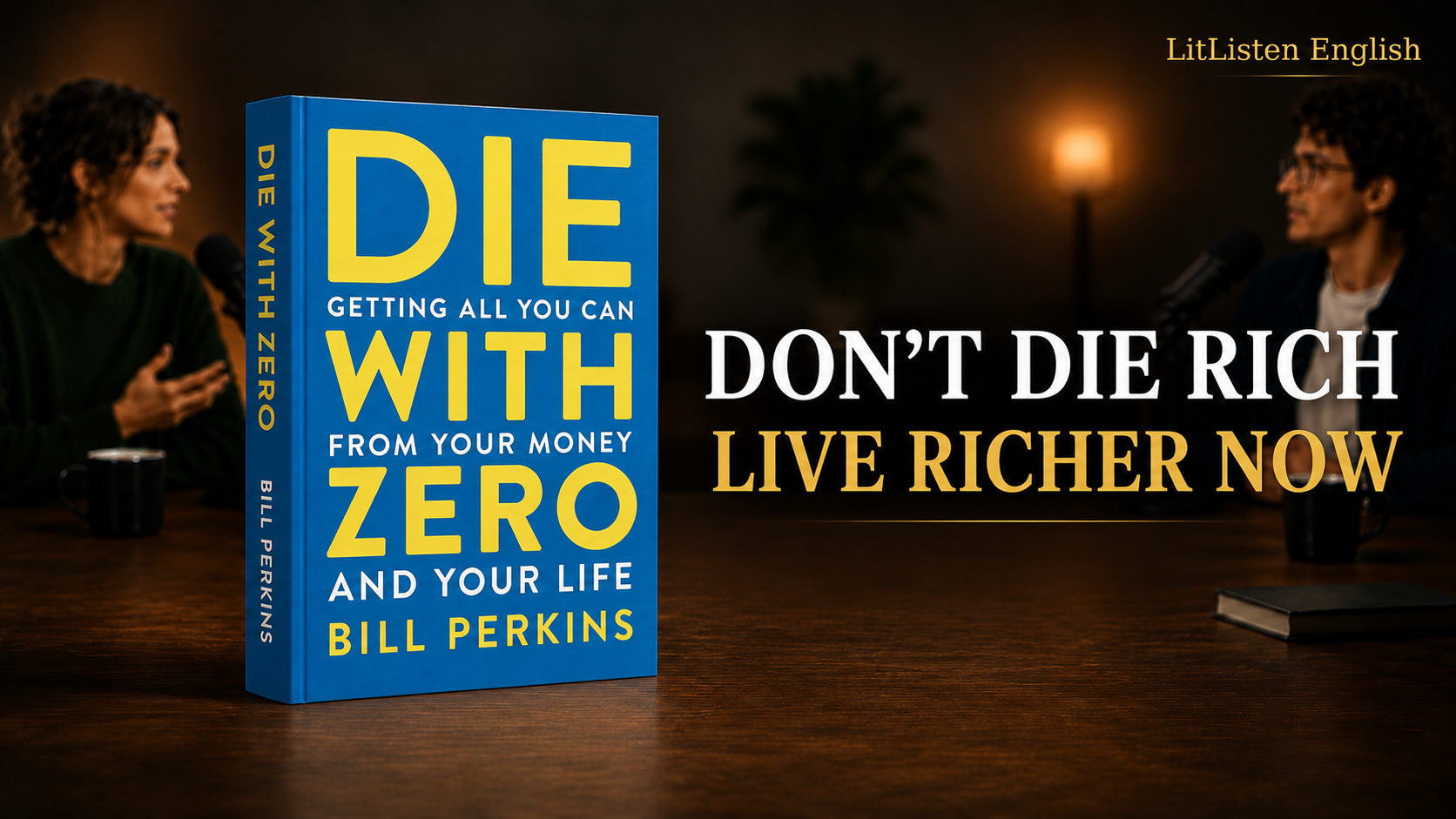
We are looking at a book called Die With Zero by Bill Perkins.
It really is a complete paradigm shift. I mean, we are so conditioned to fear running out of money, right?
Oh, constantly. That's the main fear.
Yeah. So we completely ignore the opposite risk, which is running out of life before we actually spend the money we worked so hard to earn.
Right.
Perkins is essentially offering this mathematically backed philosophy on how to maximize your life fulfillment rather than just, you know, maximizing your bank balance.
And to even begin wrapping our heads around this, we have to start by redefining what money actually is.
Like the core premise here is that money equals life energy.
Yes. That is the foundation of the entire book.
Every single dollar you earn represents a fraction of your finite time on this planet.
Because you traded hours of your life for it.
Exactly. You gave up your physical and mental energy to get that currency.
So when you look at a hundred dollar bill, you shouldn't just see purchasing power.
Right. You should see like the Tuesday afternoon you gave up to earn it.
Precisely. Which totally flips the script on the classic fable of the ant and the grasshopper.
Oh, right. We all know that story from childhood.
The industrious ant works tirelessly all summer storing up food for the winter.
While the carefree grasshopper just plays his fiddle, you know, and eventually starves when the snow falls.
Yeah. And the moral we are all taught is that we should always be the ant.
But Perkins asks this profoundly simple question.
When does the ant ever get to play?
Wow. Yeah.
Right. If the ant spends his entire short life slaving away in the dirt just to survive the winter,
he never actually gets to experience the joy of living.
He just survives.
Exactly. Our culture heavily overcelebrates the ant.
We praise people for working themselves to the bone and just hoarding resources.
And, you know, Perkins approaches this not just as some philosopher, but as someone with a very analytical background.
He was trained as an engineer and later became a really successful energy trader on Wall Street.
Yeah. And that background is crucial because he views human life as an optimization problem.
Right. Like an equation.
Basically, yeah.
In engineering, you want to maximize the output while minimizing the waste.
In life, the output is fulfillment and the waste is unspent money that you traded your life energy for.
And he shares this incredibly revealing story from his early days on Wall Street.
He was earning an entry level salary of about $18,000 a year.
Which is not much in New York.
Not at all. He was living in Manhattan in an apartment roughly the size of a pizza oven.
And he was even driving a limousine at night just to scrape by.
Just to pay the rent, basically.
Yeah. Just trying to cover his basic rent and groceries.
But he still managed to save up $1,000 and he was incredibly proud of himself.
Until his boss found out, right?
Exactly.
His boss basically called him an idiot.
Yeah.
He looked at Perkins and explained that he was starving his younger self to feed his wealthier future self.
Because his income was obviously going to grow significantly as he got older.
Right.
And the financial term for this concept is consumption smoothing.
Okay. Let's take a quick pause here, actually.
This is a great natural spot for our English learners to digest these concepts.
And we have a couple of great vocabulary words to highlight.
Oh, perfect. Yeah. Let's do it.
So the first phrase we want to focus on is on autopilot.
That's O-N-N space A-U-T-O-P-I-L-O-T.
On autopilot.
Right. Which means doing things automatically without actively thinking about them.
Exactly.
Like in the context of the book, it's how most people live their lives and spend their money.
They just do it on autopilot.
A simple example would be, I was so tired this morning that I drove to work on autopilot.
That is a great example.
And the second phrase we should highlight is to make ends meet.
Oh, yeah.
You use that one when talking about Perkins driving the limo.
It did. Yeah.
It means to earn just enough money to pay for basic living expenses.
Yeah.
The author notes that if you are really struggling to make ends meet, this whole die with zero philosophy might be much harder to apply.
Right. Because you're just focused on survival.
So an example in conversation would be when I was a student, I had to work two jobs just to make ends meet.
Exactly. Two very common, very useful idioms.
Okay. So getting back to the book, this idea of consumption smoothing.
I want to push back on this a little bit.
Sure.
Because isn't it incredibly irresponsible to not rack up savings when you're young?
I mean, it feels like breaking the fundamental rule of adulthood.
It goes against everything we're taught. Yeah.
Right. It feels like we are taught to treat life as a giant game of Space Invaders, where the ultimate goal is just to rack up a massive high score on the screen before the game ends.
And that score is your net worth.
That is exactly how a lot of people treat it. Like a game of Space Invaders.
But the author argues that the true high score of life is not your bank balance.
It's not.
No. The true high score is your accumulated experiences.
You don't get any bonus points at the end of the game for the lives you didn't use or the coins you didn't spend.
That makes sense.
The universe doesn't care if you die with $10,000 or $10 million.
Okay. So if the goal is to optimize for experiences, how do we actually do that?
Because going back to our vocabulary word, most people are just living on autopilot, following the standard path of working and saving.
To get off autopilot, you have to understand a concept Perkins calls the memory dividend.
The memory dividend.
Yeah. It explains exactly why buying an experience early in life is mathematically far more valuable than buying it later.
I really love this concept.
Yeah.
Because when you buy an experience, say like a trip to Italy or tickets to a huge concert, you don't just enjoy it in that one specific moment.
Precisely. It pays out emotional interest every single time you recall it.
Right.
You experience the joy when it happens, but then you get a dividend when you tell the story at a dinner party a year later.
You get another dividend when you look at a photograph five years later and feel that same rush.
Even technology companies understand the underlying psychology of this.
You know, think about Facebook or Google Photos.
Oh, but those memories features.
Yeah.
They have those algorithms pop up and say, on this day, five years ago, they're literally monetizing our memory dividends.
They really are.
They know that reminding us of our past experiences gives us a psychological boost, which keeps us engaged with their apps.
It is a compounding asset.
Right.
And because it compounds, the timing matters immensely.
Like, Perkins shares this story about his former roommate, Jason.
Oh, the Europe trip.
Right.
When Jason was in his early 20s, he desperately wanted to backpack across Europe for a few months, but he had zero money.
So he borrowed about $10,000 from a loan shark to fund the trip.
Okay, hold on.
Borrowing from a loan shark sounds financially ruinous.
I just want to say, I definitely do not recommend our listeners go find a loan shark.
No, definitely not.
And Perkins thought the exact same thing at the time.
He thought Jason was out of his mind.
But Jason went anyway.
He just went for it.
Yeah, and he didn't have a strict itinerary.
He just decided to, well, this brings up another great vocabulary phrase.
He decided to fly by the seat of his pants.
Oh, that's a perfect one.
Let's define that for the trainees.
To fly by the seat of your pants means to do something by relying on your own instincts in the moment rather than having a clear plan.
Exactly.
So an example would be we didn't plan an itinerary for our vacation.
We just decided to fly by the seat of our pants.
Right.
So Jason is flying by the seat of his pants in Europe.
Yeah, figuring out where to sleep and eat day by day.
And he came back with these unbelievable, life-defining stories.
He slept in questionable hostels, ate cheap baguettes in parks, met fascinating people.
Meanwhile, Perkins, being the responsible aunt, waited until he was 30 to finally go to Europe.
And by then he had a lot more money, but he realized he had missed a very specific window.
He felt too old, didn't he?
He felt too old, too tired for loud youth hostels.
He didn't want to carry a heavy backpack.
The experience was just completely different.
So an experience is like a stock that pays emotional dividends for the rest of your life, meaning buying it at 20 yields decades more interest than buying it at 60.
Exactly. Jason bought that stock early.
And even though taking a high interest loan was extreme, Jace maintains to this day that he wouldn't trade those memories for any amount of money.
Wow. Okay.
So if you accept that money is life energy and that experiences are the true currency of life, then leaving money behind when you die basically means you left experiences on the table.
It means you squandered your time. And actually, there's our next vocabulary, word to squander. S-Q-U-A-N-D-E-R.
Great word. To squander means to waste money, time, or an opportunity in a foolish or careless way.
Right. For example, you could say he won the lottery but squandered all the money on expensive cars in just one year.
Perfect. So we usually worry about squandering our money, but Perkins argues we should be terrified of squandering our limited time.
Terrified of it. Because if you die with $50,000 in your bank account, you didn't just leave behind paper.
You left behind thousands of hours of your life that you spent in an office working for that money.
Hours you could have spent with your family or traveling or just, you know, relaxing.
He gives a really striking hypothetical example in the book about a woman named Elizabeth, doesn't he?
Yes. Elizabeth is your classic frugal worker. She saves diligently her entire career.
She retires at age 65 with $770,000 in her portfolio.
That's a solid retirement.
It is. And she lives a very modest, careful retirement and eventually passes away at age 85, leaving $130,000 behind.
From a traditional financial planning perspective, she won. I mean, she didn't run out of money.
But under Perkins' philosophy, she literally wasted years of her life working for money she never even used.
She could have retired two or three years earlier.
That worked a four-day week for her last decade on the job.
Exactly. She just kept working out of pure habit.
And the book points to real-world examples, too, like the billionaire John Arnold.
Oh, right.
He made hundreds of millions of dollars, enough to fund a thousand lifetimes, but he just couldn't stop working.
The psychological habit of accumulating wealth just became stronger than the desire to actually live his life.
Yes. The accumulation became the goal rather than a tool to facilitate life.
Okay. I understand the philosophy, but I have to play devil's advocate here.
This raises a very real, honestly terrifying, logistical question.
I think I know what you're going to ask.
If I actively try to spend down my money so that I die with exactly zero, what happens if I live to be 100 years old?
I absolutely do not want to be 92 years old, completely broke, and unable to afford medical care.
That is the single biggest psychological barrier to this entire concept.
In the financial world, it's called longevity risk, the risk that your lifespan outpaces your wealth span.
Right. So how do we fix that?
Well, Perkins, being an engineer, has a mathematical solution to this problem.
So you can spend down your wealth safely.
First, he recommends using data.
Data.
Yeah. Don't just guess your lifespan.
Use sophisticated life expectancy calculators like actuarial tables.
They take into account your health, your family history, and your lifestyle to give you a highly probable estimate of your remaining years.
But I mean, an estimate is still just an estimate.
It doesn't eliminate the risk of being that one statistical outlier who happens to live to 105.
Exactly. Which is why his second recommendation is to transfer that risk entirely by purchasing financial products called annuities.
Okay. Let's explain how annuities actually work.
Yeah.
Because this is the safety net that makes dying with zero possible.
Think of an annuity as the complete opposite of life insurance.
With life insurance, you pay a little bit every month so that if you die early, your family gets a huge lump sum.
Right.
An annuity flips that.
You give an insurance company a large lump sum of cash up front.
And in exchange, they legally guarantee to pay you a set monthly income for the absolute rest of your life, even if you live to be 110.
But how can the insurance company afford to do that? What if everyone lives to be 110?
It comes down to the mechanism of risk pooling. The insurance company takes money from thousands and thousands of people.
Statistically, they know that some of those people will unfortunately pass away at 75, while others will live to 95.
Oh, I see.
Yeah. So the money from the people who die earlier subsidizes the payouts for the people who live longer.
By pooling the risk, the insurance company can guarantee your income, which completely removes the terror of running out of money.
So once you have an annuity covering your basic survival costs, you are entirely free to spend your remaining cash on fulfilling experiences without any fear.
Precisely.
Okay. That makes the math work. But there is another massive objection people have to this book.
When you say the phrase die with zero, the immediate emotional reaction is that it sounds incredibly selfish.
Oh, completely.
People immediately think, well, what about my kids? What about leaving a legacy or giving to charity?
It is the most common pushback. People proudly declare they are saving their wealth for their children.
But Perkins has a remarkably sharp counter argument to this.
Let's hear it.
He argues that waiting to leave an inheritance until the day you die is actually the opposite of caring.
He calls it the three R's, meaning you are leaving wealth transfer to random amounts, random times, and random people.
Okay, let's unpack those three R's.
First, because you don't know the exact date of your death, the amount of money left over is completely random.
Second, the timing is random. You have no idea what age your children will be when they finally inherit.
Right.
And third, to be brutally honest, you don't even know for sure which of your heirs will outlive you.
Leaving an inheritance in a will means you aren't actively giving.
Dead people cannot be generous.
Wow. That's a harsh way to put it, but it's true.
Your money is just being legally reassigned by a court after you're gone.
Exactly.
And the timing aspect is crucial here because Perkins introduces the idea of a biological peak for receiving money.
Yes. Research shows that the optimal time for a person to receive a financial windfall is between the ages of 26 and 35.
Right.
Why that specific window, though?
Because that is when money has the absolute maximum compounding impact on a person's life trajectory.
In your late 20s and early 30s, you're likely trying to buy your first house or pay off crushing student loans or afford child care for a new baby.
Yeah, true.
A dollar given at age 30 can be invested in a home that appreciates in value, or it can relieve immense daily stress.
But if we look at the data, when do most people actually inherit money?
Usually in their late 50s or 60s because people are living longer.
By the time your children are 60, their kids are already grown, their house is probably paid off, and they're already established.
Right. Remember that analogy we talked about earlier? Treating life like a game of space invaders.
Well, waiting to give your kids money when you die at 86 means they'll get it when they are 60.
It's like offering a giant glass of water to someone decades after they were stranded in the desert.
Yes.
Sure, water is always nice, but they aren't dying of thirst anymore.
Give them the water when they are actually in the desert. Give them the money when it can actually change their lives.
And this exact same logic applies to charity.
The book contrasts two very different types of giving.
It tells the story of Sylvia Bloom, a legal secretary who lived incredibly frugally, riding the subway and pinching pennies.
I remember this.
Yeah. And when she died at age 96, it was revealed she had quietly amassed an $8.2 million fortune, which she left entirely to charity in her will.
Which is a beautiful gesture, obviously.
But think about the mechanism of time.
If she had given that money away 30 years earlier, it could have been funding scholarships or building shelters or doing vital research for three decades.
Exactly.
Perkins contrasts her with billionaires like Chuck Feeney or Robert F. Smith, who aggressively gave their wealth away while they were still alive and healthy.
Because they solved real world problems immediately.
Right. And they got to experience the profound joy of witnessing the impact of their generosity.
But giving your wealth away intentionally at the right time requires us to face a very difficult philosophical truth about life.
Yes, it does.
Our health, our interests, and our relationships are constantly shifting.
And this brings us to one of the most profound concepts in the book, time bucketing, and the idea of mini deaths.
This is where the book shifts from just financial advice to deep philosophy.
We tend to think of death as a single event at the very end of the timeline.
But Perkins argues that we actually die a multitude of deaths throughout our lives.
It sounds dark at first, but it's actually a beautiful plea to live in the present.
Think about it.
The teenager version of you is already dead.
The college student version of you who could stay up all night with friends dead.
Yeah.
The version of you that was the parent of a toddler who held a little hand crossing the street,
that version dies when the child grows up.
You pass through these very distinct temporary seasons of life.
He shares a story that completely broke my heart, but made the point perfectly.
When his daughters were little, he loved watching Pooh's Heffalump movie with them.
It was their special thing.
Oh, yeah.
Then one day, he suggested they watch it, and his 10-year-old daughter just politely said no.
She wasn't interested anymore.
She had outgrown it.
That specific window of experience had permanently closed.
You cannot delay certain experiences indefinitely because you assume you will always have the time and the health to do them.
Right.
You cannot take a teenager to Disney World for the first time.
No, you can't.
And you cannot backpack across Europe sleeping on floors when you're 75 with a bad back.
Because these windows close, Perkins says we need to actively map out our experiences into different time buckets based on our age.
You literally make a list of what you want to do in your 30s, your 40s, and your 60s, factoring in your declining physical health.
And this connects to the ultimate financial mechanism in the book, The Net Worth Peak.
Most of us are conditioned to believe that our net worth graph should just go up and up and up until the day we die.
Right.
But mathematically, if you want to maximize your experiences, provide for your kids at the optimal age, and actually die with zero, that graph must have a peak.
There has to be a specific day where you stop accumulating and start actively decumulating.
Yes.
For most people, depending on their health and earnings, this net worth peak should occur somewhere between the ages of 45 and 60.
That is the moment you must flip the psychological switch.
You have to start spending down your wealth.
Because if you wait until you are 70 to start spending, you'll physically run out of health and energy long before you run out of money.
But what if someone pushes back and says,
I don't want to stop.
I actually love my job.
I love going to the office.
I love the intellectual challenge.
Why shouldn't they just keep earning?
Well, Perkins acknowledges that some people truly derive immense fulfillment from their work.
Right.
But the mechanism remains exactly the same.
Even if you love your job, if you are working to accumulate money that you will literally never spend, you are still throwing away your life energy.
Wow.
You are trading time you could be spending with your spouse or mentoring others or traveling just to add numbers to a screen that will outlive you.
His advice is, if you love your work, keep working.
But you must actively spend or give away the money you earn.
Don't let it sit there rotting in a bank account.
So if we pull all these threads together, what does this all mean for you listening right now?
True wealth is not a number.
True wealth is a beautifully curated collection of memories.
Aiming to die with zero forces you to wake up.
It really does.
It forces you to stop blindly saving for a tomorrow that isn't guaranteed and start intentionally designing your life today.
It forces you to invest in experiences when they will yield the highest memory dividend and to support your loved ones and charities when they actually need it.
It's about acknowledging our mortality to optimize the brief, beautiful time we have.
Before we wrap up, I want to leave you with one final, incredibly provocative thought from the author.
Oh, the app?
Yeah.
He talks about an app you can download called the Final Countdown.
Imagine setting up this app on your phone.
It uses actuarial tables to calculate your statistical life expectancy.
And it counts down the exact number of days you have left to live.
It's chilling.
If you pulled your phone out of your pocket right now and saw exactly how many healthy weekends you have left before you die, would you really spend this coming Saturday working extra hours for cash you don't actually need?
It is a staggering thought experiment.
It strips away all the illusions we have about infinite time.
It really does.
Well, we want to thank all of you for joining us for this deep dive on Lit Listen English.
We hope you take these concepts and the vocabulary we explored today and apply them to your own financial and personal choices.
It has been a fantastic journey unpacking these ideas with you.
Remember, the ultimate goal isn't just to look at a bank statement on your last day on Earth and see a jagged line hitting exactly zero dollars.
The goal is to look back at the life you lived and see an overflowing, vibrant reservoir of memories knowing you didn't leave a single drop of your precious life energy unspent.
Keep listening, keep exploring, and we will catch you on the next deep dive.